Pages

November 6, 2009

Bordeaux, France.


Bordeaux has been around since Roman times when it was capital of Aquitana Secunda, in around the 3rd century BC. Bordeaux has had two great financial booms in its time. The first was when Eleanor of Aquitaine married Henry II of England in 1152, thus beginning a 300-year period of English rule and kick-starting the export wine trade (the English were very fond of the red wine they called claret)

Then in the 18th century colonial trade brought riches to Bordeaux and paid for the central architecture. The centre is attractive and quite small, so even if you are just stopping off here on the way somewhere else, you could easily discover Bordeaux's charms in a day. The 18th-century town stretches from the western banks of the River Garonne to the cathedral in the west and the place de la Comédie in the north. Any Roman remains are further north in the Jardin Public, but there is not much to speak of.

Top 10 countries to visit in 2009

The travel gurus at Lonely Planet have come up with what they say is the definitive list of what to do and where to go in 2009, and in a condensed format for today's time-strapped travellers.

The Best in Travel 2009, published this month, is a compilation of lists of 850 destinations, journeys and experiences recommended by the guide book publishers. And the longest entry is two pages long.

"We want people to open the book, point their finger and come up with something different every time," said Ben Handicott, Lonely Planet associate publisher.

"We want people to be able to dip in and out of content, to basically be able to get some ideas and plan their trip on the plane. I guess it's the effect of the internet."

As well as lists such as "Most Spine-Tingling Commutes" and "Best Places for Deadly Sins", the guide book includes the top 10 countries, and top 10 regions, travellers must visit next year. There is also a month-by-month trip planner, as well as country profiles and statistics.

Unlike more in-depth guides, there are no restaurant or hotel recommendations.

One of the highlights of the book is a section dedicated to water, aimed at today's more environmentally conscious travellers, Handicott said.

"Climate change is an issue affecting all of us and water is such a major issue everywhere these days," he said. "Water is also just a great traveller. Some of the first significant travel of humanity took place over water."

Tony Wheeler, Lonely Planet's co-founder, introduces the book with his own list, which includes visiting a country whose name ends in "-stan" such as Afghanistan or Kyrgyzstan, finding a trip that involves sailing, such as a transatlantic cruise, staying for a long time in one place to soak up the atmosphere or going on a long trip, such as a trek across the Sahara or a Cairo-to-Capetown bicycle ride.

Here are Lonely Planet's list of top 10 countries to visit:

1. Algeria

2. Bangladesh

3. Canada

4. Georgia

5. Greenland

6. Kyrgyzstan

7. Oman

8. Peru

source
http://www.mindfood.com/at-top-10-countries-visit-2009-travel-tips-trip.seo

Winnie The Pooh : The Pooh Poems


Furry Bear
If I were a bear,
And a big bear too,
I shouldn’t much care
If it froze or snew;
I shouldn’t much mind
If it snowed or friz —
I’d be all fur-lined
With a coat like his!

For I’d have fur boots and a brown fur wrap,
And brown fur knickers and a big fur cap.
I’d have a fur muffle-ruff to cover my jaws,
And brown fur mittens on my big brown paws.
With a big brown furry-down up to my head,
I’d sleep all the winter in a big fur bed.


(Tiddly Pom)
The more it goes
(Tiddly Pom)
The more it goes
(Tiddly Pom)
On snowing.

And nobody knows
(Tiddly Pom)
How cold my toes
(Tiddly Pom)
How cold my toes
(Tiddly Pom)
Are growing.

The more it snows
(Tiddly Pom)
The more it goes
(Tiddly Pom)
The more it goes
(Tiddly Pom)
On snowing.

And nobody knows
(Tiddly Pom)
How gold my toes
(Tiddly Pom)
How cold my toes
(Tiddly Pom)
Are growing.


It's a very funny thought that, if bears were bees,
They'd build nests at the bottom of trees.
And that being so (if the bees were bears)
We shouldn't have to climb up all these stairs.

source
http://www.winniethepooh.co.uk/storiesandpoems.html

November 4, 2009

Lewis Carroll Quotes: Alice in Wonderland


When you read Alice in Wonderland, you will find yourself trying to make sense of an illogical story. Alice, the key character, also experiences similar frustrations. But in the end, she emerges wiser with the learning involved in each situation. Everyone faces absurd choices in life. If you shrug off these choices as anomalies to your perfect life, you gain nothing. But if you try to learn from these absurdities, you will gain a lot of wisdom.
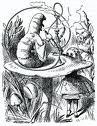
The Caterpillar and Alice: Quotes: Alice in Wonderland
The Caterpillar: What size do you want to be?
Alice: Oh, I'm not particular as to size, only one doesn't like changing so often, you know.


Alice and the Cat: Quotes: Alice in Wonderland
Alice: Would you tell me, please, which way I ought to go from here?
The Cat: That depends a good deal on where you want to get to
Alice: I don't much care where.
The Cat: Then it doesn't much matter which way you go.
Alice: …so long as I get somewhere.
The Cat: Oh, you're sure to do that, if only you walk long enough.

Alice and the Cat: Quotes: Alice in Wonderland
The Cat: By-the-bye, what became of the baby? I'd nearly forgotten to ask.
Alice: It turned into a pig.
The Cat: I thought it would.

March Hare and Alice: Quotes: Alice in Wonderland
March Hare: Have some wine.
(Alice looked all round the table, but there was nothing on it but tea.)
Alice: I don't see any wine.
March Hare: There isn't any.
Alice: Then it wasn't very civil of you to offer it.
March Hare: It wasn't very civil of you to sit down without being invited.

Alice and March Hare: Quotes: Alice in Wonderland
March Hare: …Then you should say what you mean.
Alice: I do; at least - at least I mean what I say -- that's the same thing, you know.
Hatter: Not the same thing a bit! Why, you might just as well say that, 'I see what I eat' is the same as 'I eat what I see'!
March Hare: You might just as well say, that "I like what I get" is the same thing as "I get what I like"!
The Dormouse: You might just as well say, that "I breathe when I sleep" is the same thing as "I sleep when I breathe"!

Alice and the Hatter: Quotes: Alice in Wonderland
Alice: What a funny watch! It tells the day of the month, and it doesn't tell what o'clock it is!
The Hatter: Why should it? Does your watch tell you what year it is?
Alice: Of course not, but that's because it stays the same year for such a long time together.
The Hatter: …which is just the case with mine.

The Duchess and Alice: Quotes: Alice in Wonderland
The Duchess: You're thinking about something, my dear, and that makes you forget to talk. I can't tell you just now what the moral of that is, but I shall remember it in a bit.
Alice: Perhaps it hasn't one.
The Duchess: Tut, tut, child! Everything's got a moral, if only you can find it.

The Duchess and Alice: Quotes: Alice in Wonderland
The Duchess: Be what you would seem to be -- or, if you'd like it put more simply -- Never imagine yourself not to be otherwise than what it might appear to others that what you were or might have been was not otherwise than what you had been would have appeared to them to be otherwise.
Alice: I think I should understand that better, if I had it written down: but I can't quite follow it as you say it.

Alice and the Dormouse: Quotes: Alice in Wonderland
The Dormouse: You've got no right to grow here.
Alice: Don't talk nonsense. You know you're growing too.
The Dormouse: Yes, but I grow at a reasonable pace, not in that ridiculous fashion.

Alice and the Duchess: Quotes: Alice in Wonderland
Alice: I didn't know that Cheshire cats always grinned; in fact, I didn't know that cats could grin.
The Duchess: You don't know much; and that's a fact.

Alice and the Pigeon: Quotes: Alice in Wonderland
Alice: But I'm NOT a serpent, I tell you! I'm a -- I'm a --
The Pigeon: Well! WHAT are you? I can see you're trying to invent something!
Alice: I -- I'm a little girl.
The Pigeon: A likely story indeed! I've seen a good many little girls in my time, but never ONE with such a neck as that! No, no! You're a serpent; and there's no use denying it. I suppose you'll be telling me next that you never tasted an egg!


November 3, 2009

Travelling with photo equipment

Photography is an expansive art form that includes more than just portraiture, landscape or glamor photography. Both professional and amateur photographers may favor specific types of photography over others. While a professional photographer may work in photojournalism, an amateur may be particularly interested in macro-photography. Read on to learn more about the various types of photography.
Traveling with photo equipment can get complicated, but traveling without photo equipment would be pointless to anyone who loves photography, so here are some pointers that should take some of the stress out of it.

1. If you’re flying, carry your camera onboard with you to avoid damage. When you go through metal detectors, ask the attendant to hand-screen your film. To help expedite hand-screening, carry your film in clear canisters or remove it from its packaging and place it in clear plastic bags.

If you can buy film where you’re headed, consider waiting until you get there to purchase it. It’ll at least make one leg of your trip easier going through screening devices.

Do not pack unprocessed film in checked luggage. The scanner equipment is stronger than the ones used for carryon bags, and may well fog your film.

Check your airline’s web site to find out carry-on and checked-luggage policies. Some overseas airlines or small airlines do not allow you to carry luggage onto the plane with you.

Digital media are not affected by x-rays, but magnetic devices could harm them. Because there may be powerful magnets in the motors of conveyor belts, place your camera as far away from the beginning of the belt as possible.

2. If you’re traveling by car, keep your camera inside when you’re driving so it will stay cool. Carry it with you when you leave your car; it can easily be stolen out of the trunk.

3. Always, but always, keep your eye on your equipment. It takes only a couple of seconds for anyone to grab an unattended camera bag. Dangling a camera from your neck isn’t a good idea, either; it’s very easy to cut a strap with a quick cut of a sharp knife.

4. Know what you’re going to do about storing digital images before your trip begins. Personally, I prefer memory cards. Lugging around a computer or portable storage devices is a hassle. If I’m particularly protective about images, I either go to a one-hour lab and have them download the images to a CD or I go to a cyber cafe and download the images to an online image bank. If I need more memory cards, I just buy them. They’re not hard to find. If I think they may be hard to find, I take extra ones with me. You can never have too many memory cards.

5. Insure your equipment. See if your insurance company already covers your equipment in case of theft or damage. If it doesn’t, get a policy that will, especially if you’re traveling with thousands of dollars worth of equipment.

6. Unless you know your camera inside and out, take your manual with you. Just pack it in your luggage.

7. Make sure you take all your cords, etc. with you. If anything needs an outlet, bring an electric plug adapter if you’ll travel overseas. Bring one for your car, too, if you’ll be doing a lot of shooting in the field.

8. Protect your camera from inclement weather.

9. Avoid leaving your gear in extreme heat.

10. If it rains unexpectedly, the very least you should do is get your camera under an item of clothes to shield it the best you can. Get out of the rain.

11. If it’s cold, warm your camera up with your body heat to avoid condensation. If condensation does occur, empty the battery and memory compartments and keep the compartments open until they’re dry. If you take them back outside with condensation, they may freeze, and that’s bad news.

12. Use a UV filter to protect your lens.

13. Take equipment you’re familiar with. Traveling isn’t the time to try out new equipment if you want to be confident you’ll get good results.

14. Travel light with a good bag. Don’t bring every lens or body you have “just in case.” By limiting yourself, you may also find new ways of seeing.

15. If you’re going overseas, declare all your photo equipment with custom officials at the airport before you leave so you won’t have to prove ownership when you return.

by Nancy Hill
source
photography.com

Musicophilia: The Tales of Music and The Brain


Music can move us to the heights or depths of emotion. It can persuade us to buy something, or remind us of our first date. It can lift us out of depression when nothing else can. It can get us dancing to its beat. But the power of music goes much, much further. Indeed, music occupies more areas of our brain than language does--humans are a musical species.

Oliver Sacks's compassionate, compelling tales of people struggling to adapt to different neurological conditions have fundamentally changed the way we think of our own brains, and of the human experience. In Musicophilia, he examines the powers of music through the individual experiences of patients, musicians, and everyday people--from a man who is struck by lightning and suddenly inspired to become a pianist at the age of forty-two, to an entire group of children with Williams syndrome who are hypermusical from birth; from people with "amusia," to whom a symphony sounds like the clattering of pots and pans, to a man whose memory spans only seven seconds--for everything but music.

Our exquisite sensitivity to music can sometimes go wrong: Sacks explores how catchy tunes can subject us to hours of mental replay, and how a surprising number of people acquire nonstop musical hallucinations that assault them night and day. Yet far more frequently, music goes right: Sacks describes how music can animate people with Parkinson's disease who cannot otherwise move, give words to stroke patients who cannot otherwise speak, and calm and organize people whose memories are ravaged by Alzheimer's or amnesia.

Music is irresistible, haunting, and unforgettable, and in Musicophilia, Oliver Sacks tells us why.

source
http://www.oliversacks.com/musicophilia.htm

November 2, 2009

The Cassiopeia


Cassiopeia
Cassiopeia was the wife of Cepheus, the Ethiopian king, and the mother of Andromeda. The asterism clearly shows the chair upon which Cassiopeia sits. It looks like a shape of "W", and is a guide to find out the Polar Star like the Big Dipper. Japanese had given the asterism names of "The stars of Anchor" or "The stars of shape of mountains", and so on. The constellation is bathed in the faint autumn's Milky Way, so includes various nebulae and star clusters. The dense band of the Milky Way passing through Cassiopeia shows that it lies on the plane of our Galaxy. The familiar W-shaped constellation looks out towards the Galaxy's rim. Cassiopeia's constellation straddles the Milky Way in the far northern sky, neighbouring the constellations dedicated to her husband King Cepheus, her daughter Andromeda, and Andromeda's rescuer Perseus.
Stars
The familiar 'W' of Cassiopeia is made up from five stars, Segin, Ksora, Cih, Schedir and Caph. The central star Cih is the brightest of these (at magnitude +2.2), while Caph is the closest of the five to Earth's Solar System at 55 light years. By a curious coincidence, all five of these stars are variables. In particular, Cih can vary by nearly 5% of a magnitude, and is the prototype of a class of irregular variables, 'Gamma Cassiopeiae' variables, that periodically cast off rings of matter.

Also notable among the stars of Cassiopeia is Achird, a fairly bright star roughly half-way between Cih and Schedir. This yellow binary, though not as bright as some of Cassiopeia's other stars, is much closer to Earth, at roughly nineteen light years' distance.
Star Clusters
Cassiopeia includes a number of open clusters, but none of these is visible to the naked eye. Particularly notable are two Messier objects, M52 and, close to Ksora in the sky, M103. Another cluster, NGC 457, can be found near the distant star Phi Cassiopeiae. All of these clusters are young (no more than 35 million years old), and their distances range between five and ten thousand light years, in the direction of the Galaxy's rim.
Supernovae
Cassiopeia has been the site of two supernovae in historical times. The first occurred in 1572, and reached a maximum magnitude of roughly -4, making it brighter than Venus in the sky. The second took place nearly a century later, leaving a shattered region that is still detectable today, especially by radio telescopes, and is designated Cassiopeia A. These stellar explosions took place about 10,000 light years away.

SOURCE
http://home.xtra.co.nz/hosts/Wingmakers/Cassiopeia.html